Revolutionary Microscopy: Bridging the Tiny and the Extraordinary
In a remarkable leap for scientific exploration, researchers have unveiled a groundbreaking microscope that promises to transform how we perceive the miniature world. This innovation is set to catalyze advancements in multiple scientific domains, from biology to material science, offering unprecedented insights into the structures that govern much of our technology and life itself.
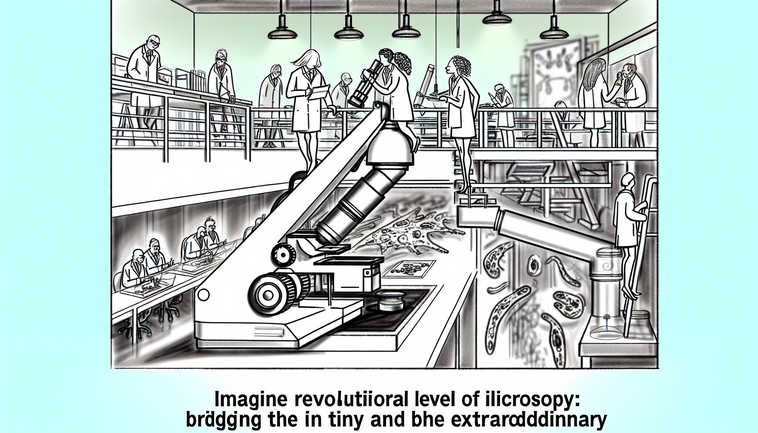
The new microscope, characterized by its advanced capabilities, allows scientists to observe tiny particles with a clarity that was unattainable in the past. This technological marvel combines cutting-edge optics and imaging software to provide images of unprecedented resolution. Such enhancement in microscope efficacy opens up new avenues for research, providing a deeper understanding of cellular activities and material properties.
Historically, microscopes have been pivotal in numerous scientific breakthroughs. The ability to view cells and bacteria essentially brought the world into an era of modern medicine. With this new development, we’re entering a phase where even the most minute interactions at the nanoscale can be scrutinized, perhaps leading us to new discoveries about life at the atomic level.
One of the most exciting applications of this microscope is in the field of nanotechnology. Researchers can now observe and manipulate nanoparticles with greater precision, potentially leading to breakthroughs in drug delivery systems, electronic and photonic devices, and even in environmental monitoring. This tool could very well spark a new wave of innovation in nanotechnology, emphasizing precision engineering and science.
Moreover, the implications for biological sciences are equally compelling. Understanding the complex behaviors of proteins, nucleic acids, or pathogens in their natural environment could revolutionize areas such as genomics and disease pathology. Scientists now have the means to observe cellular processes in real time and with exceptional detail, promising a future where diseases can be understood and treated with unprecedented efficiency.
Despite the excitement, the microscope also presents challenges, primarily in how data from such instruments can be managed and interpreted. With high-resolution imaging comes the creation of vast amounts of data, necessitating advances in computational methods and data processing technologies. Collaboration between biologists, physicists, and computer scientists is more crucial than ever to harness the full potential of this innovation.
As we stand on the cusp of a new era of scientific exploration, it is important to embrace both the opportunities and challenges presented by this powerful tool. The ability to view the minutiae of life and matter in such detail will undoubtedly accelerate discoveries that could fundamentally change our understanding of the world. In harnessing this potential, we not only expand the boundaries of science but also enhance our capabilities to address some of the most pressing issues facing humanity today.