October 4th: The Day Our Eyes Turned Skyward
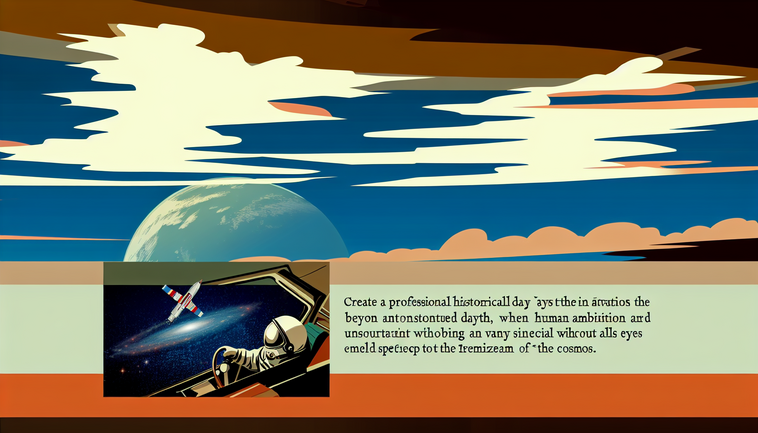
Today, as we chart our calendars on October 4th, we are reminded of a pivotal moment in history that transformed human ambition beyond the confines of Earth. It was on this day in 1957 that the Soviet Union launched Sputnik, the world’s first artificial satellite. This groundbreaking milestone catalyzed what would come to be known as the Space Age, altering how generations perceived and pursued the cosmos.
Sputnik’s launch was a wake-up call across the globe, particularly in the United States. The small, spherical satellite, equipped with four long antennas, emitted radio pulses detectable across vast distances. The beeping sounds transmitted from Sputnik were not just a technological achievement but a clarion call to the rest of the world, triggering a fierce space race between superpowers that would define the Cold War era.
Reflecting on Sputnik’s impact, one must appreciate how it redefined governmental priorities. With space exploration suddenly front and center, nations poured immense resources into scientific research and technological innovation. The United States responded promptly by establishing the National Aeronautics and Space Administration (NASA) just a year later in 1958. This became the seedbed for technological advancements that have changed everyday life, from satellite communications to GPS navigation.
Besides igniting competitive spirits between nations, the launch of Sputnik fostered a period of rapid scientific collaboration and education. As countries invested in creating a robust technological workforce, educational systems saw a massive influx of support for STEM (Science, Technology, Engineering, and Mathematics). The aspiration to send humans to the stars had stirred an unprecedented interest and belief in science.
Sputnik’s journey has also been a source of inspiration and nostalgia. Generations of astronomers, physicists, and engineers cite this historical event as their spark of curiosity. It showcased that what seemed like a distant dream could become an achievable reality with ingenuity and perseverance. Sputnik didn’t just orbit the Earth; it orbited the imaginations of millions, fueling dreams of interstellar travel and extraterrestrial possibility.
However, this extraordinary leap wasn’t without its challenges. The space race raised pressing questions about weaponization, national security, and the ethical implications of space exploration. As we commemorate Sputnik’s launch, we must remember the dual face of discovery: potential and responsibility. Each step into the cosmos bears the weight of maintaining peace and promoting progress for all of humanity.
In looking back at that historic October 4th and the ripple effects of Sputnik’s journey, we understand that stars once distant are now within our reach. Our enduring legacy is not simply about reaching the cosmos, but what reaching the cosmos tells us about ourselves: our endless curiosity and our capacity to dream beyond our horizons. Today reminds us not just of what we achieved, but what is still possible when humanity comes together, eyes turned skyward.